America's Future Military Allies in Asia
America’s Future Military Allies in Asia
By MOHAN SAHAY
America has taken a step forward to broaden its operational military base in Asia by signing the Hyde Act of Nuclear treaty with India. The US President George W. Bush appended his signature on Monday the 18th of December 2006.
Future historian would concur at latter years of 21st Century that the move to placate India was aimed at getting yet another military ally in South Asia. No matter who the ruler of Pakistan would be in future, the country can’t afford to rebuff Washington, though present Pakistani President Gen. Parvez Musharraff and the US President George Bush enjoy best of diplomatic and personal equation and both overcame worst phase of history during the first 12 months of post 9 / 11 global war on terror.
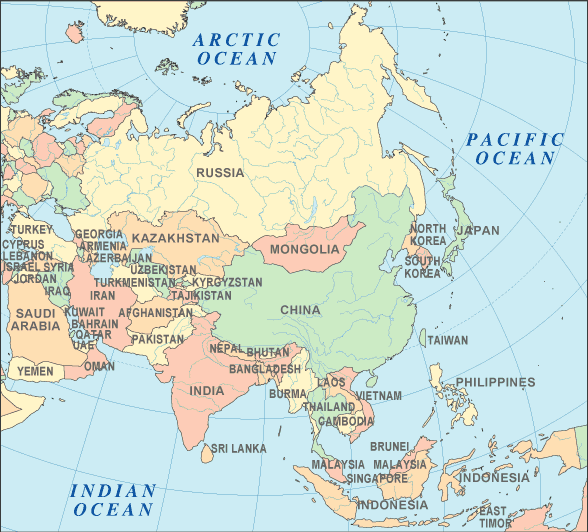
Afghanistanistan depends on the US not only for military aide but also to crush the terrorists Al Qaida and Talibans who are regrouping to overthrow the Karzai government in Kabul. America would never allow the return of Talibans in that country. The presence of the US forces in Afghanistan are there to stay and would be reinforced in future as the military challenges grow in the region.
Iran is raising its ugly heads threatening America with its plan to acquire nuclear strike capability. Ruled by radical Islamic political groups, Teheran shares its borders with Afghanistan. The US can only hope to strengthen its military presence in the region by gaining some military operational base in India – a border state of Afghanistan.
Already, Islamabad has permitted limited operational facilities to the US defence forces in Pakistan though there is no declared military alliance between the two countries..
Strategically, Pentagon need active military support of Pakistan and Afghanistan to keep under check Iran.
The US also needs some contingency military back up to check Russia and other smaller countries of the subcontinent despite Moscow and Washington sharing a friendly relation. So is the case with China vis a vis US economic interests. Besides, America can never trust the two Asian Super Powers.
Given the power equation in Asia, India is the only country that is growing economically at faster pace and is in a position to emerge as a military power in the region in future. As of now, though, India lacks military strength desired to dominate in the region. Its army is devoid of funds. Inventories are poor and there are fewer replacement of strike weapons. Manpower suffer due poor perks and salaries to not only Indian Army but also to Indian Air Force and Indian Navy.
Lack of Political will on part of the Indian rulers who are elected heads of the government to strengthen the Indian defence apparatus is the root cause of the weakening strike power of the country.
Apprehensions in India about the US treaty that might restrict development of our nuclear strike capability in future appear based on unsound logistics. The question of India going for another nuclear explosion for military purposes would arise only when the country reaches the stage of optimization of its already developed nuclear technology in making nuclear bombs and develop further laser guided strike capability whether on cruise missiles warheads or on warheads of aerial strikes.
Sadly, it may take a decade or more before India is able to exploit its military gains of being a nuclear power.
Washington may be well informed about India’s military prowess specially nuclear strike capability than any other country in the world. Hence, George Bush was able to convince his own critics back home who too had objected to White House making special concessions to India in acquiring nuclear fuel supply from America and other countries.
It is in Washington interest that India grows not only as an economic power but also as a military power in the region. Since it is India, a democratic power in the world that can stand by America – be it containing terror in Pakistan or fighting Talibans in Afghanistan or keeping the two super powers – Russia and China from spreading their tentacles in India and South Asia.
Time is not far off when next step of Washington would be to provide military aides to India and instead ask for some operational space in the region on Indian soils.
ends
posted by MOHAN SAHAY at 11:00 PM
0 comments


